
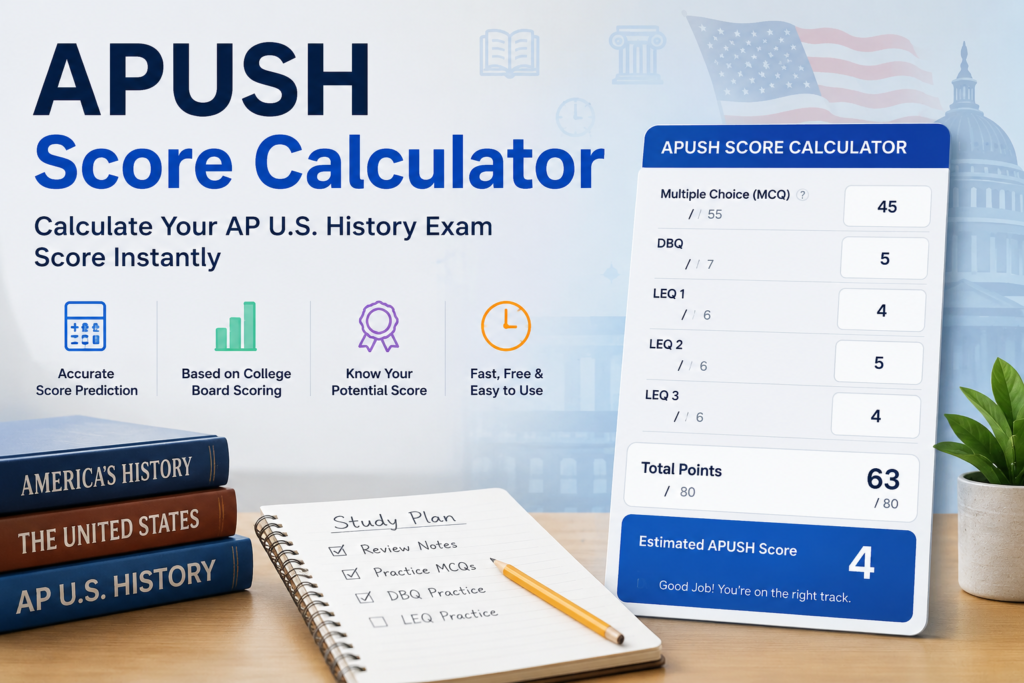
If you’ve been preparing for the AP U.S. History exam, you’ve probably already wondered how your multiple-choice and DBQ scores translate into a final AP score. However, many students still misunderstand how the APUSH scoring system actually works and which sections impact the final result the most. In this guide, we’ll explain how an APUSH score calculator works, how to estimate your score accurately, and what strategies can help you earn a 4 or 5.
APUSH Score Calculator
📊 APUSH Score Calculator
Calculate your estimated AP US History exam score
| Component | Score | Weight |
|---|---|---|
| MCQ | 0 | 45% |
| SAQ | 0 | 20% |
| DBQ | 0 | 25% |
| LEQ (Best) | 0 | 10% |
MCQ: 0.9 points per correct answer (max 49.5 points)
SAQ: 1.5 points per question (max 18 points)
DBQ: 1.25× points (max 8.75 points)
LEQ: Best of two essays × 1.67 (max 10 points)
Total: 86.25 → Scaled to 120 points for AP Score conversion
Key Takeaways
- APUSH score calculators estimate your final AP score by combining multiple-choice, short-answer, DBQ, and long-essay performance.
- The DBQ and LEQ sections carry major weight and often determine whether you earn a 3, 4, or 5.
- AP U.S. History scoring changes slightly each year because College Board adjusts score curves based on exam difficulty.
- Practice exams improve score prediction accuracy because they simulate real timing and section weighting.
- Students who regularly review rubric-based feedback often improve faster than students who only memorize historical facts.
- Time management directly impacts APUSH scores because incomplete FRQs reduce potential points quickly.
- APUSH score calculators help identify weak sections early so you can prioritize study time effectively.
What Is an APUSH Score Calculator?
An APUSH score calculator is a tool that estimates your final AP U.S. History exam score based on your raw section scores.
First, the calculator converts your performance in multiple-choice questions, short-answer responses, document-based questions (DBQs), and long essays into a composite score. Then, it compares that estimated composite score against historical AP score curves to predict whether you will earn a 1, 2, 3, 4, or 5.
For example, if you score highly on the DBQ but struggle with multiple-choice questions, an APUSH score calculator can show how much your essay performance offsets weaker sections. This insight can help you study more strategically before exam day.
Moreover, AP U.S. History remains one of the most popular AP exams in the United States, with over 488,000 students taking the exam in 2024 — Source: College Board, 2024.
APUSH score prediction tools simplify complex grading formulas.
How Does the APUSH Scoring System Work?
The APUSH scoring system combines weighted section scores into a final composite score that maps to the AP 1–5 scale.
Currently, the AP U.S. History exam includes:
| Section | Weight | Question Type |
| Multiple Choice Questions (MCQ) | 40% | 55 questions |
| Short Answer Questions (SAQ) | 20% | 3 questions |
| Document-Based Question (DBQ) | 25% | 1 essay |
| Long Essay Question (LEQ) | 15% | 1 essay |
For example, a student with strong historical reasoning skills may earn higher DBQ and LEQ scores even with average MCQ performance. This balance can significantly improve the final AP score estimate.
Additionally, the College Board uses scaled scoring rather than fixed percentages. That means a raw score of 70% may still translate into a 4 depending on exam difficulty.
Why Does an APUSH Score Calculator Matter?
An APUSH score calculator matters because it helps students predict outcomes and improve weak areas before the actual exam.
First, score calculators reduce uncertainty. Many students feel overwhelmed because APUSH combines content memorization with analytical writing. A calculator breaks that complexity into measurable targets.
For example, if your calculator estimate shows that your DBQ performance is limiting you to a projected 3, you can focus specifically on sourcing, contextualization, and evidence integration.
Moreover, practice testing strongly correlates with higher AP performance. Students who complete at least three timed practice exams score significantly higher on average — Source: Educational Testing Service, 2023.
Targeted practice improves APUSH outcomes faster than passive studying.
Why Does an APUSH Score Calculator Matter?
An APUSH score calculator matters because it helps students predict outcomes and improve weak areas before the actual exam.
First, score calculators reduce uncertainty. Many students feel overwhelmed because APUSH combines content memorization with analytical writing. A calculator breaks that complexity into measurable targets.
For example, if your calculator estimate shows that your DBQ performance is limiting you to a projected 3, you can focus specifically on sourcing, contextualization, and evidence integration.
Moreover, practice testing strongly correlates with higher AP performance. Students who complete at least three timed practice exams score significantly higher on average — Source: Educational Testing Service, 2023.
Targeted practice improves APUSH outcomes faster than passive studying.
Why Students Use APUSH Score Calculators Before Exam Day
An APUSH score calculator helps students create realistic score goals before taking official practice tests.
Students commonly use calculators to:
- Estimate their chances of earning college credit
- Benchmark practice exam performance
- Identify weak writing sections
- Track progress over time
- Reduce test anxiety through predictable scoring
For example, a student aiming for a 5 may discover they only need modest MCQ improvement if their DBQ scores remain consistently high.
At the same time, calculators also help teachers structure review sessions around high-impact sections.
How Can You Calculate Your APUSH Score Accurately?
You can calculate your APUSH score accurately by using official section weightings and realistic practice exam results.
First, collect your raw scores from a full-length APUSH practice test. Then, apply weighted percentages based on the official exam structure.
Step 1: Calculate Your Multiple-Choice Score
The multiple-choice section contributes 40% of your final APUSH score.
For example, if you answer 44 out of 55 questions correctly, your raw accuracy is 80%. That percentage contributes heavily toward your composite score.
Moreover, strong MCQ performance often indicates solid historical content retention and contextual understanding.
Step 2: Score Your SAQ Responses
The short-answer section measures concise historical reasoning and evidence usage.
Typically, each SAQ contains three possible points. Students earn credit by directly answering prompts and supporting claims with historical evidence.
For example, a response discussing Reconstruction policies should include specific legislation or historical outcomes rather than vague summaries.
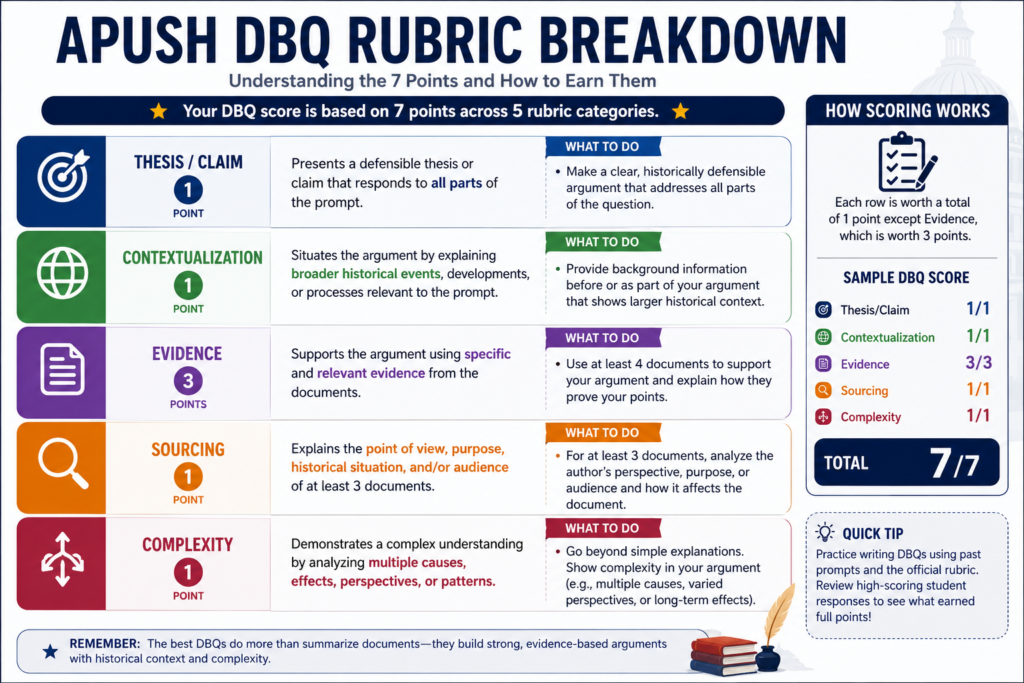
Step 3: Grade Your DBQ and LEQ Using Official Rubrics
The DBQ and LEQ sections evaluate analytical writing and historical argumentation.
First, use College Board rubrics to assess thesis quality, contextualization, evidence integration, and complexity. Then, convert those rubric points into weighted composite values.
Students who consistently practice DBQs often improve rapidly because rubric categories are highly teachable.
For example, adding outside evidence correctly can immediately increase your DBQ score potential.
According to College Board scoring data, essay rubric alignment remains one of the strongest predictors of AP history success — Source: College Board Research, 2023.
Rubric familiarity increases APUSH writing efficiency.
What APUSH Score Do You Need to Pass?
A passing APUSH score is typically a 3 or higher on the official AP scale.
Generally, most colleges grant some form of credit or placement for scores of 3, 4, or 5. However, highly competitive universities often require a 4 or 5 for meaningful credit.
Here is a general historical conversion estimate:
| AP Score | Approximate Composite Score Range |
|---|---|
| 5 | 75–100 |
| 4 | 60–74 |
| 3 | 45–59 |
| 2 | 30–44 |
| 1 | 0–29 |
For example, students targeting selective universities should usually aim for at least a 4 because many institutions limit credit for lower scores.
Additionally, AP U.S. History pass rates fluctuate annually. In 2024, approximately 72% of students earned a score of 3 or higher — Source: College Board, 2024.
APUSH composite score ranges shift slightly every year.
What Are the Best Strategies to Improve Your APUSH Score?
The best strategies to improve your APUSH score include timed practice, rubric analysis, and historical reasoning drills.
First, prioritize active recall over passive reading. Simply rereading textbook chapters rarely improves exam performance significantly.
For example, students who self-test using flashcards, SAQs, and practice DBQs often retain historical periods more effectively.
Focus on Historical Thinking Skills
Historical thinking skills are core APUSH scoring criteria used throughout the exam.
These skills include:
- Causation
- Continuity and change over time
- Comparison
- Contextualization
- Argument development
Moreover, AP readers reward analytical depth more than simple memorization. That means connecting events matters more than listing dates.
Practice Timed Essays Weekly
Timed essay practice improves speed, structure, and evidence integration under exam pressure.
For example, writing one DBQ and one LEQ weekly helps students build stronger thesis statements and historical complexity points.
Additionally, students who regularly practice under timed conditions often report lower exam-day stress.
Research shows retrieval-based practice improves long-term retention by up to 50% compared to rereading
Source: Carnegie Mellon University – Retrieval Practice ResearchTimed writing practice strengthens historical argument quality.
Which Tools Can Help You Use an APUSH Score Calculator?
Several tools can help you estimate APUSH scores and improve exam preparation more effectively.
First, official College Board practice exams provide the most reliable scoring benchmarks because they mirror real exam difficulty and formatting.
Second, online APUSH score calculators automate weighting calculations and historical score conversions.
Recommended APUSH Study and Score Prediction Tools
| Tool | Best Use | Free or Paid |
|---|---|---|
| College Board AP Classroom | Official practice questions | Free |
| Albert.io APUSH Calculator | Score prediction | Free |
| Fiveable APUSH Guides | Content review | Freemium |
| Khan Academy U.S. History | Historical concept review | Free |
For example, Albert.io calculators allow students to input estimated rubric scores and instantly predict composite outcomes.
What Should You Do After Calculating Your APUSH Score?
After calculating your APUSH score, you should build a targeted improvement plan based on your weakest sections.
First, analyze whether your score limitations come from historical content gaps or writing execution issues. Then, allocate study time proportionally.
For example:
- Low MCQ accuracy → Review historical periods and causation.
- Weak SAQs → Practice concise evidence-based responses.
- Low DBQ scores → Improve sourcing and contextualization.
- Weak LEQs → Strengthen thesis structure and argument flow.
Moreover, students who track score trends weekly often improve more consistently than students who study randomly.
Consistent feedback loops accelerate APUSH score improvement.
Conclusion
An APUSH score calculator is one of the most effective tools for estimating your AP U.S. History exam performance before test day. By understanding section weightings, practicing with official rubrics, and tracking your progress consistently, you can identify weaknesses early and study more strategically.
More importantly, APUSH success depends on historical reasoning as much as factual knowledge. By practicing timed essays, reviewing scoring rubrics, and using realistic score predictions, you can approach exam day with greater confidence and a clearer strategy.