
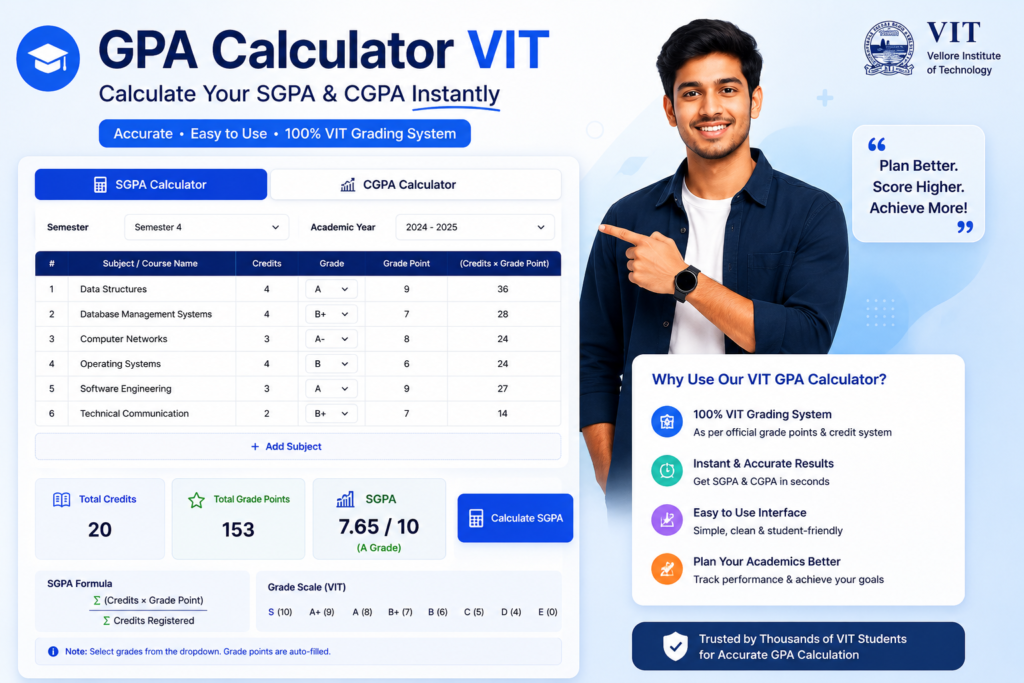
You probably already know that GPA plays a major role in placements, internships, and academic standing at VIT. But many students still calculate their GPA incorrectly because they misunderstand credit weighting, grade points, or CGPA formulas while using a GPA Calculator VIT tool. In this guide, you’ll learn exactly how the VIT GPA system works, how to calculate SGPA and CGPA step by step, and how to use a GPA Calculator VIT accurately for better academic planning.
🎓 VIT GPA Calculator
Calculate Your Semester GPA & CGPA Instantly
Key Takeaways
- GPA Calculator VIT is based on subject credits multiplied by grade points earned in each course.
- SGPA measures performance for one semester, while CGPA combines grades across all semesters.
- Higher-credit subjects have a greater impact on GPA than lower-credit subjects.
- A VIT GPA calculator helps students estimate academic performance quickly and accurately.
- Manual GPA calculation involves dividing total weighted grade points by total registered credits.
- Regular GPA tracking helps students meet placement, scholarship, and higher education requirements.
- Improving grades in high-credit subjects can significantly increase overall CGPA.
What Is a GPA Calculator VIT Students?
A GPA calculator VIT is a tool that helps students calculate their SGPA and CGPA using VIT’s credit-based grading system. The calculator automatically converts grade points and subject credits into semester-wise or cumulative GPA values.
Moreover, VIT follows a credit-based academic grading system where each subject carries a specific credit value. Your final GPA depends not only on grades but also on the weight of each course. For example, scoring an “A” in a 4-credit subject impacts your GPA more than scoring the same grade in a 2-credit lab course.
“VIT GPA calculation is based on the weighted average of grade points earned across all registered course credits.”
According to the University Grants Commission, over 75% of Indian universities now use some form of CBCS or credit-based evaluation — Source: UGC, 2024.
How Does the VIT Grading System Work?
The VIT grading system assigns grade points to letter grades earned in each subject. These grade points are then multiplied by the credits assigned to the course.
Here’s a simplified version of the common VIT grading structure:
| Grade | Grade Point |
|---|---|
| S | 10 |
| A | 9 |
| B | 8 |
| C | 7 |
| D | 6 |
| E | 5 |
| F | 0 |
For example, if you score an “A” in a 4-credit subject, your weighted score becomes:
9×4=36
Difference Between GPA, SGPA, and CGPA
SGPA refers to the GPA earned in one semester, while CGPA represents cumulative performance across all completed semesters.
“SGPA measures academic performance for a single semester, while CGPA represents cumulative performance across multiple semesters.”
For example:
- Semester 1 SGPA = 8.2
- Semester 2 SGPA = 8.8
- Semester 3 SGPA = 9.1
Your CGPA combines all semester credits and weighted grade points together.
In addition, students often confuse percentage with CGPA. However, GPA is a weighted academic score, while percentage represents marks converted into a 100-point scale.
Why Does GPA Calculation Matter at VIT?
GPA calculation matters at VIT because academic performance directly affects placements, internships, scholarships, and higher education opportunities.
According to NACE internship research, students with higher GPAs are statistically more likely to receive internship interview calls — Source: National Association of Colleges and Employers, 2024.
Why GPA Matters for Placements
A good CGPA improves eligibility for campus recruitment and technical interviews. Many recruiters set minimum CGPA cutoffs during placement drives.
For example:
- Core engineering companies often require 7.0–8.0 CGPA
- Product-based companies may prefer 8.5+
- Higher studies applications usually target 8.0+
“A VIT GPA calculator helps students estimate academic standing, placement eligibility, and semester performance quickly and accurately.”
Why GPA Matters for Scholarships and Internships
Scholarships often require maintaining a minimum CGPA throughout the semester. Similarly, research internships and exchange programs also evaluate GPA heavily.
For example, students applying for semester-abroad programs usually need consistent academic performance above a predefined threshold.
Furthermore, many internship portals shortlist candidates using GPA filters before resume evaluation.
Why GPA Tracking Prevents Academic Problems
Regular GPA tracking helps students avoid academic probation and identify weak subjects early.
According to AICTE student performance studies, consistent academic monitoring improves semester outcomes by nearly 18% — Source: AICTE Academic Analytics Report, 2023.
For example, if your GPA drops after mid-semester exams, you can prioritize high-credit subjects before final assessments.
How Is SGPA Calculated in VIT?
SGPA in VIT is calculated by dividing total weighted grade points by total semester credits.
“CGPA calculation involves dividing the total earned weighted grade points by the total number of completed credits.”
The standard SGPA formula is:
SGPA=∑Credits∑(Grade Points×Credits)
Step-by-Step SGPA Calculation Example
Let’s calculate SGPA for a typical engineering semester.
| Subject | Credits | Grade | Grade Point | Weighted Score |
|---|---|---|---|---|
| Mathematics | 4 | A | 9 | 36 |
| Physics | 3 | B | 8 | 24 |
| Programming | 4 | S | 10 | 40 |
| Lab | 2 | A | 9 | 18 |
| English | 2 | B | 8 | 16 |
Total Weighted Score = 134
Total Credits = 15
Final SGPA:
SGPA=15134=8.93
Therefore, the student’s SGPA becomes 8.93.
How Do Credits Affect GPA Calculation at VIT?
Credits affect GPA because higher-credit subjects contribute more weight to your overall SGPA and CGPA.
“Higher-credit subjects contribute more heavily to overall GPA than lower-credit courses.”
For example, improving from a “B” to an “A” in a 4-credit mathematics subject increases GPA more than improving a 1-credit seminar course.
Can You Calculate VIT GPA Manually Without a Tool?
Yes, students can calculate VIT GPA manually using credits and grade points.
First, list all registered subjects.
Second, multiply each subject’s grade point by its credits.
Third, add all weighted scores together.
Finally, divide by total credits.
Manual calculation is especially useful when predicting results before official grade publication.
How Do You Calculate CGPA in VIT?
CGPA in VIT is calculated by combining weighted scores from all semesters and dividing them by total completed credits.
The CGPA formula is:
CGPA=∑(Total Credits)∑(Semester Weighted Points)
Example of CGPA Calculation Across Semesters
Suppose a student has the following performance:
| Semester | Credits | SGPA | Weighted Score |
|---|---|---|---|
| Semester 1 | 20 | 8.5 | 170 |
| Semester 2 | 22 | 8.8 | 193.6 |
| Semester 3 | 21 | 9.0 | 189 |
Total Weighted Score = 552.6
Total Credits = 63
Final CGPA:
CGPA=63552.6=8.77
Therefore, the cumulative CGPA becomes 8.77.
How Are Backlogs or Failed Subjects Counted in VIT CGPA?
Failed subjects usually receive zero grade points until cleared through re-examination or improvement attempts.
For example, an “F” grade contributes zero weighted points while still affecting registered credits. This can significantly reduce SGPA.
However, once students clear the backlog, updated grades may replace earlier scores according to institutional academic policy.
How Do You Convert VIT CGPA Into Percentage?
VIT CGPA conversion typically uses institution-approved conversion formulas for official applications.
A commonly used approximation is:
Percentage=CGPA×9.5
For Examples:
8.5×9.5=80.75%
However, students should verify official conversion methods from their department or transcript guidelines.
Which Is the Best Online VIT GPA Calculator?
The best online VIT GPA calculator is one that supports VIT-specific credits, grading patterns, SGPA calculation, and CGPA prediction.
According to Statista education technology data, over 67% of university students now use digital academic tracking tools — Source: Statista, 2024.
Best Types of GPA Calculation Tools
Students commonly use:
- Web-based VIT SGPA calculators
- Spreadsheet GPA templates
- Mobile GPA tracking apps
- Academic dashboards
For example, spreadsheet templates are excellent for semester-wise planning because they allow future-grade prediction.
Spreadsheet-Based GPA Tracking
Spreadsheet GPA trackers help students monitor academic trends over time.
For example, you can create columns for:
- Subject name
- Credits
- Expected grade
- Actual grade
- Semester GPA
This method works especially well for long-term CGPA planning.
Common GPA Calculation Mistakes to Avoid
Students often make avoidable GPA calculation mistakes that lead to incorrect estimates.
Common errors include:
- Ignoring course credits
- Using incorrect grade-point mapping
- Forgetting failed subjects
- Mixing SGPA and CGPA
- Calculating percentage incorrectly
For example, assuming all subjects carry equal weight can dramatically inflate predicted GPA.
What Is a Good CGPA for Placements at VIT?
A good CGPA for placements at VIT generally ranges between 8.0 and 9.0 depending on the company and industry.
According to India Skills employment reports, recruiters increasingly use academic filtering during initial hiring rounds — Source: India Skills Report, 2024.
CGPA Benchmarks for Different Goals
| Goal | Recommended CGPA |
|---|---|
| Basic placement eligibility | 6.5–7.0 |
| Core engineering roles | 7.5–8.0 |
| Product-based companies | 8.5+ |
| MS abroad applications | 8.0+ |
| Research internships | 8.5+ |
Why Consistency Matters More Than One Semester
Consistent improvement across semesters creates a stronger academic profile than one exceptionally high SGPA.
For example, a student improving steadily from 7.2 to 8.5 demonstrates adaptability and discipline.
Additionally, recruiters often evaluate trends rather than isolated semester performance.
How Can Students Improve Their GPA at VIT?
Students can improve GPA at VIT by prioritizing high-credit subjects, tracking weak areas early, and following structured semester planning.
Focus on High-Credit Courses First
Improving grades in high-credit subjects produces faster CGPA improvement.
For example, increasing a 4-credit course grade from “B” to “S” has a larger impact than improving a 1-credit lab.
Build a Semester Study Strategy
Structured semester planning improves consistency and reduces last-minute stress.
Students should:
- Track internal assessment dates
- Prepare weekly revision schedules
- Solve previous-year papers
- Focus on attendance requirements
Use Productivity and Note-Taking Tools
Digital study tools help engineering students organize lectures, assignments, and revision plans efficiently.
Popular tools include:
- Notion
- OneNote
- Google Keep
- Obsidian
For example, organizing formula sheets before exams reduces revision time significantly.
Improve Time Management Before Exams
Time management directly affects GPA because rushed preparation reduces conceptual understanding.
According to Harvard academic productivity research, planned study schedules improve retention rates by over 25% — Source: Harvard Learning Research, 2023.
Conclusion
VIT GPA calculation becomes straightforward once you understand grade points, credits, and weighted averages. SGPA measures semester performance, while CGPA reflects your cumulative academic progress across all semesters.
More importantly, regular GPA tracking helps students prepare strategically for placements, scholarships, internships, and higher education opportunities. By focusing on high-credit subjects, planning semesters carefully, and using accurate GPA calculators, you can steadily improve your academic performance over time.
Remember, GPA is not just a number. It is a long-term indicator of consistency, discipline, and academic growth. Start tracking your performance early, set realistic goals, and make every semester count.